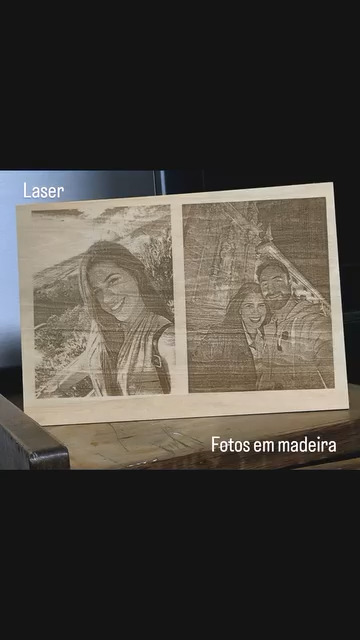
A piece that only existed on Instagram
This engraving was made for a colleague and sold. Photographs engraved in solid limewood aren't experiments to give away: they involve materials, time, preparation and the risk of discovering too late that the chosen image won't cooperate.
Until now, the piece's only public record was on Instagram.
It's two photographs engraved side by side in limewood.
The equipment is still the same 12 W diode laser that, according to catalogue logic, ought probably to stick to writing names on chopping boards.
Two photographs aren't the same problem
An image can look perfectly normal on a phone and become terrible when it needs translating into wood. Faces, shadows, backgrounds, clothing and landscape compete for a far narrower tonal range than the screen offers.
The source photographs were taken in opposite conditions too: one by day, the other at night.
With my colleague beside me, we tried the websites usually recommended for preparing photographs for laser engraving. It was a little tour led by the whole internet — automatic tools, promised conversions and solutions that should ready an image in a few clicks.
None removed the need for manual work. Before the laser touched the wood, it took about 30 minutes in Paint.NET to bring the quality, detail and tonal readability close enough.
Having the customer nearby isn't an inconvenience or poor organisation. It's part of how I work.
Whenever possible, I'd rather the person visit the workshop, watch the decisions happen and understand why a seemingly simple photograph may need so much preparation. They don't just receive a finished piece without context; they follow part of the story they'll tell when someone asks where it was made.
In this case the customer is also a friend and knows the workshop's techniques. He's in the small group that knows more than the site reveals — and still gets surprised by what can come from supermarket materials.
Word leads to word. Someone who watched the process enthusiastically explains it to someone else — and many commissions begin that way.
That work disappears in the finished result. Nobody looks at the piece and sees half an hour spent recovering information, balancing two incompatible images and trying to stop a face becoming a dark blot. They just see the wood — precisely the aim.
One of these photographs came dangerously close to going completely wrong.
Then the wood moved halfway through engraving.
It wasn't deliberately repositioned or instructed to cooperate artistically. It simply decided to move of its own accord, because wood sometimes has a will of its own and picks the worst moments to demonstrate it.
The result keeps the evidence: a “subtle” tilt of around 10 degrees. Subtle in the sense that the piece survived, so everyone diplomatically agreed to call it subtle.
In photographic engraving, a seemingly insignificant movement can shift detail, double outlines and ruin correspondence between passes. After two incompatible images had been prepared, the physical support added a third variable to the experiment.
The final record doesn't entirely hide the struggle. The right-hand image is much closer to the limit, with dense areas and difficult separations. Yet the faces remain recognisable and both memories coexist on the same board.
The result was brilliant — not because the source images were perfect, but because the wood accepted enough information to preserve what mattered.
When my colleague received the piece, he summed it up:
“Despite the tilt, the photographs look brilliant. I didn't know the laser could steal so much detail.”
It can — if you teach it.
The diode doesn't look at a photograph and decide on its own which eyes, faces or shadows matter. It receives a prepared image, a chosen surface and decisions about what information should survive the move to wood.
The number on the box doesn't make the piece
Twelve watts tell you how much power the diode has. Nothing about image preparation, tonal reading, wood selection or the tests needed before trusting a photograph to a board with no undo button.
This piece isn't a demonstration of power.
It's a demonstration of negotiation.