One thing in person. Another on the phone.
Photographing a laser engraving with a modern phone ought to be easy. The camera has resolution, HDR, artificial intelligence and enough ability to recognise the Moon from kilometres away.
Then you point it at a piece and half the effect disappears.
Engravings depend on tiny differences between lines, texture, shine and shadow. That's where the sense of depth lives. The phone sees those differences and immediately starts helping:
- sharpens;
- reduces what it interprets as noise;
- balances shadows and highlights;
- enhances outlines;
- combines several exposures;
- decides how the surface should look.
By the time it's finished, the photograph is technically cleaner and visually less accurate.
Photography became interpretation
Artificial intelligence is now involved in almost every stage too. It's nice for selfies: recognises faces, balances skin, recovers shadows and tries to ensure nobody looks as if they were photographed in a basement.
An art piece doesn't need that favour.
The aim isn't to obtain the version of a surface the phone finds most pleasing. It's to document colour, texture, relief and contrast as faithfully as possible. When processing decides to separate the object from the background, clean away microtexture or selectively strengthen outlines, it stops recording the piece and starts interpreting it.
Learning this cost a lot of time. Around 90% of the first photographs used on the site were taken quickly with a phone. The pieces were there, the files had good resolution and the images looked acceptable.
The work didn't show.
Depth differences went flat, finishes lost character and surfaces that changed with the light in person just looked grey. The portfolio documented the pieces' existence, but not what made them special.
When the photograph is all that remains

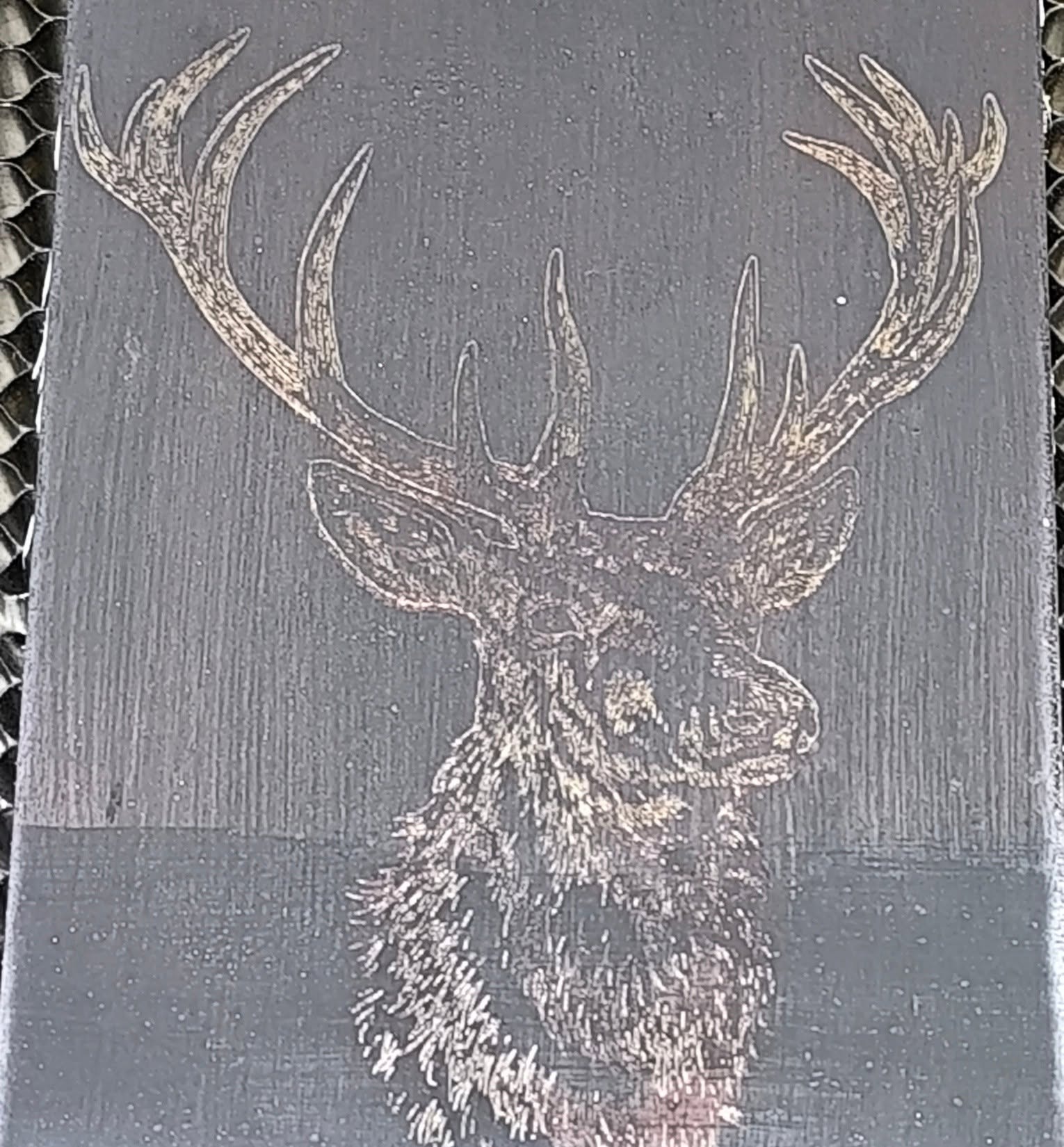
This piece was made with an original technique and then given away. It isn't in the workshop any more and probably can't ever be photographed again in the same conditions.
Even in this record it still looks like aged metal, pressed leather or a moulded relief. Outlines advance, dark areas recede and texture gives weight to something that's still wood.
But the photograph is now the limit of what the site can show. If the phone removed some finish variation, that information can't truly be recovered later. An algorithm can raise contrast or invent sharpness; it can't observe a surface that's no longer there.
It was a hurried photograph. It became the only document of hours of work and a technique that physically existed in a unique piece.
The deer that looks like a 3D transfer
The piece in this note is wood, although the surface suggests metal, printing or a raised transfer.
In person, the antlers visually project forward, the face gains volume and the fur seems to occupy several planes. The photograph still conveys the effect, but compresses some of the separation your eyes see directly.
The method used to produce that effect remains private. The problem of photographing it can be public — particularly because it's almost comic.
The Yashica beat the phone
A Yashica Digimate 100, compact and far less interested in reinterpreting reality, gets better results.
Not because it has more technology. Precisely because it has less.
The camera records light, texture and contrast without trying to turn every tiny variation into a computational decision. In this case, a supposedly inferior machine is more faithful to the object.
It isn't a scientific rule for every piece and every camera yet. It's a fairly consistent workbench conclusion:
The crummier the camera, the less it ruins the engraving.
Sometimes the best tool is the one that hasn't learnt to be clever yet.